About Vietnamese lacquer
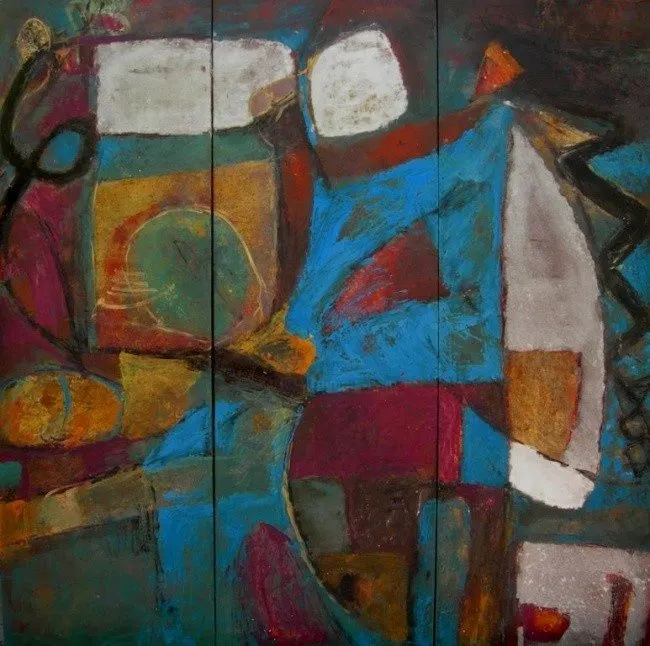
Hoa Vu on the history, materials and technique of Vietnamese lacquer painting.
A short history
Lacquer began as a popular art. It was first used to decorate and gild the paintings and statues of pagodas, then found everyday use in crafts: screens, chests, trays, vases, chessboards. Teaching of the lacquer technique began around 1930 at the École des Beaux-Arts de l’Indochine in Hanoi, founded by the Frenchman Victor Tardieu. From then on, students and artists took up lacquer and developed it for painting. For many years the process was kept as a national secret. Only around 1970 could foreign students learn the technique at the Hanoi School of Fine Arts.
The materials
What is called “lacquer” is a milky sap taken from the lacquer tree, which grows mostly in mountain areas, together with mineral powders that make the different colours. With a few natural products added, the sap turns into resin.
Resins and colours. Raw resin, natural and brown, comes straight from the lacquer tree. It is the base of every colour mixture and is also used as a varnish. Cooked resin is beaten with an iron spatula in a cast-iron pan to set off a chemical reaction (oxidation), and is then used as the black. The other colours are mainly mineral powders; some suit the medium badly, because the resin can always oxidise. Warm colours dominate. Beaten gold and silver leaf, eggshell, mother-of-pearl powder and shell can also be laid on or dusted in.
The panel (in Vietnamese, vóc) is made by a few specialist craftsmen. It is a wooden board covered with several coats of resin mixed with sawdust and cotton. It has to withstand warping from heat and high humidity. After sanding it must be perfectly smooth. It is always black, ready to be painted.
The technique
What defines lacquer is the application of several coats of colour, each dried in humidity. Sanding then brings different forms and colours to the surface. Here chance and improvisation play their part, giving unexpected effects, and the artist can go on playing with them for as long as he wishes. Lacquer is a vast field for research and creation.
Applying the coats. Several coats are laid one over another. Each must dry completely, in humidity, and be sanded before the next is applied.
Sanding. The coats are sanded with glass paper, dry or, preferably, under a trickle of water.
Inlay. The whites come mainly from inlaid eggshell, which gives a brilliant white. Gold or silver leaf can also be used as an under-layer or a final layer, to give the painting great luminosity.
Finishing. A coat of raw resin can be applied as a varnish, to protect the painting, add shine and give it more depth. The painting can also be left raw, or rubbed and smoothed with the palm of the hand, as the artist chooses.
Today every artist can use modern techniques while playing with traditional processes and materials. Like any art, lacquer excludes no kind of creation and allows great spontaneity. The time the artist gives to it, with its many coats, drying, sanding and inlays of natural materials, and the quality of work it demands, give lacquer the “precious” character for which it is known and valued around the world.